A personal history.
I first became aware of Prince in elementary school. I remember hearing “Little Red Corvette” and “1999” on the radio. I remember the radio DJ describing him as a controversial figure before playing “Little Red Corvette” as if his music couldn’t even be presented to the public without a warning notice. I remember Prince being a topic of riveting conversation in the elementary school cafeteria. I lived in the small college town of Columbia, Missouri at the time. Someone’s older sister had driven to see Prince in concert in a bigger city (We can infer that this was either his December 4th, 1982 appearance in St. Louis or his March 19th, 1983 date in Kansas City) and according to the buzzing about the cafeteria table Prince had hauled out a bed during his concert and simulated sex. This was very cutting-edge for our group of sixth graders; scandalous and boundary-pushing with a pornographic edge.

I don’t know how much I understood Prince’s lyrics, but I knew that “Little Red Corvette” was naughty. I was raised as a Calvinist Evangelical Protestant AKA Christian Reformed and dirty lyrics were sinful, as was Prince’s referring to “judgement day” and inciting a response of willful hedonism in “1999,” which wasn’t in line with how Christians were supposed to wait for the end times. (Like Prince, we too thought the end was nigh, around the corner, and sure, why not, the year 2000. But we were going to be praying, not partying while we waited for the end.) Prince entered my awareness as a figure who would invoke religious subjects in heretical and sexual ways and sexual and heretical subjects in religious ways. He was a Dionysian figure, a “satanic” figure. A figure who was not ignorant, but rather aware of the impending apocalypse and choosing to do “wrong” and go out with a bang; a false prophet lining up sheep for damnation. Prince did not ignore the spiritual and the religious, but referenced an awareness of their serious nature while still declaring sensual and carnal pleasures to be our highest purpose while we are here facing an inevitable judgement.
As a young Christian boy I thought these radio hits had troubling lyrics; I never could have imagined the lyrics contained on the 1999 double album such as in “Let’s Pretend We’re Married” where Prince says “I want to fuck you/Look here Marsha, I’m not saying this just to be nasty/I sincerely want to fuck the taste out of your mouth” in the same song where he says, “I’m in love with God, he’s the only way.”
Part of Prince’s mystique during this era were his guitar player and keyboardist Wendy and Lisa who were rumored to be lesbians. This was unprecedented in the early ’80s media landscape. They were probably my first exposure to and awareness of a lesbian couple. At the time it seemed such a part of the spectacle that there was a really-or-just-for-show question about them, but it turns out they were a very real couple for twenty years.
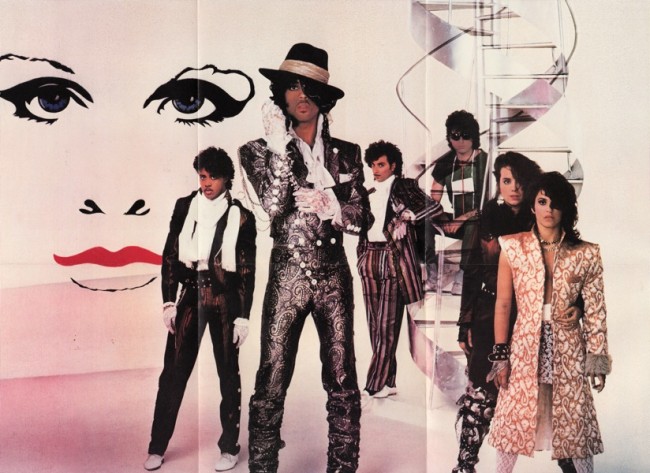
As a child I was curious about Prince and his music, but wary of this sinful imp and I didn’t love these first Prince songs I heard compared to a song that obsessed me as a sixth grader like “Beat It.”
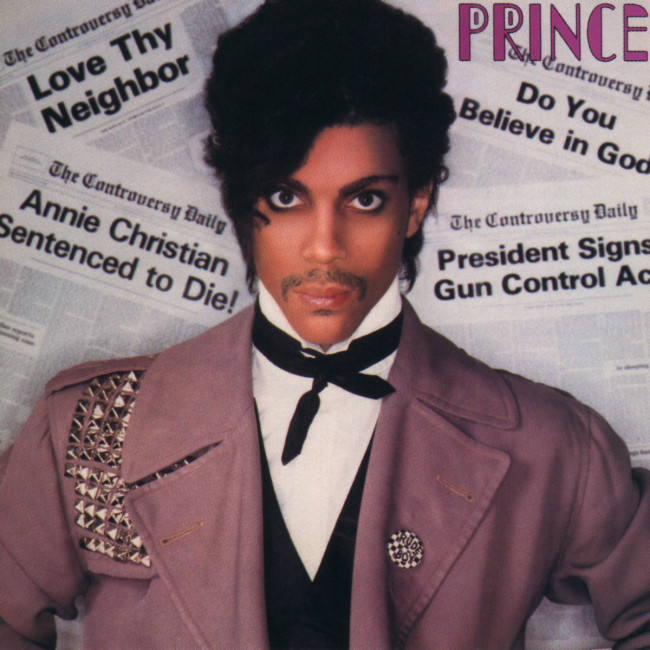
I remember seeing the striking and imposing Controversy record cover in a store, back when vinyl was on display many places besides record stores. I never heard the album until decades later, but the memory of that cover never left me.
By the time I heard “When Doves Cry” on the radio for the first time in 1984 my family had moved to Portland, Oregon. “When Doves Cry” really came out of nowhere. I had never heard anything like it. It felt like the world hadn’t either. Something brand new was before us. It was sonically startling from the first notes yet 100% pop. (Experimentation this exciting wouldn’t top the pop charts again until Timbaland and the Neptunes.) “When Doves Cry” was instantly compelling and lustfully teasing in its second person narrative. I was curious again, but still wary of this libidinous and not-quite-understandable figure who was always too carnal, too lurid, too leering for Christian comfort. Then “Let’s Go Crazy” hit the radio. I was a kid who liked songs that “rocked” so the guitar riffage overload made this the first Prince song that just straight out appealed to me, which was no doubt the point. I never saw the Purple Rain film at the time (that didn’t happen until the late ’90s), nor did I ever hear the album. Of the songs I heard on the radio those two singles were the only ones which registered with me strongly at the time. “Jungle Love” by the Time was played a lot, but I didn’t know it was a part of the film or that Prince was involved in writing it. I should have known since I found the lyrics, “Where’s your guts/You want to make love or what?” offensive in their pressuring a young woman to have sex outside of the sanctity of holy matrimony.
I remember “Raspberry Beret” as the soundtrack to driving across multiple states to visit our cousins in the summer of 1985. Prince was back with an instantly catchy and suggestive narrative and while many lyrics escaped my understanding “and if it was warm she wouldn’t wear much more” proved that Prince wasn’t going to write a song about a pretty girl in a beret without suggesting something pornographic. I knew nothing about the accompanying Around the World in A Day album.
“Kiss” came out in February of 1986 and I simply didn’t like it at all. Nothing about it appealed to me in the slightest and I was baffled as to its popularity. I should probably note that until this point my exposure to Black music in America was extremely limited as most of my musical knowledge came from furtive and infrequent listens to top 40 radio or MTV. I had no exposure to funk and only knew soul if it was on a popular soundtrack with whiteys like The Big Chill or Stand By Me. I had next to no exposure to any of the African-American musical context for Prince. I was ignorant of James Brown, Jimi Hendrix, Sly & the Family Stone, George Clinton and Parliament-Funkadelic, Marvin Gaye, the Isley Brothers, Rick James, Graham Central Station, Ohio Players, Miles Davis, Curtis Mayfield, Al Green and (pre-’80s) Stevie Wonder for starters. I was learning about James Brown through Prince as I had no idea about James Brown’s late ’60s and ’70s output which Prince drew from as a wellspring. Prince and Hiphop, who never got along much, where the two sources of Black musical history for me in the ’80s. It was a decade later before I starting digging for and discovering the original funk and soul records which so inspired Prince and Hiphop. I was hearing Prince’s tributes and Hiphop’s samples, but not the original funk and soul artists who were never featured on MTV or suburban radio or the dubbed punk and hardcore tapes passed and re-dubbed around my group of friends.
In 1986 Prince’s “Under the Cherry Moon” film came out as well. It looked silly and unappealing to me and as it was savaged by the critics it furthered my impression of an artist who had lost the plot into vanity and irrelevancy. Note that I didn’t hear his brilliant Parade album which accompanied this film until years later.
In March of 1987 Prince released the monumental Sign O’ the Times album. This will become much more important to me in later years. I saw the “U Got the Look” video on MTV that summer, but the song left me cold and I was unaware of any associated album. I did see Siskel and Ebert review the Sign O’ the Times concert film and I was surprised at how positive they were about the film and an artist who I thought was long past his Purple Rain peak. At some point towards the end of high school I was in a special one-day workshop with some older Black actors and one of the actors testified about the Sign O’ the Times album and the song “Sign O’ the Times” in particular and clearly revered Prince as a serious artist making important statements about the world which kind of blew my mind as I didn’t realize that people considered him an important artistic figure worth following beyond hit singles. I never listened to the album around this time but I filed this testimonial away in my memory banks.
I had a friend in high school named Sam who was mostly into punk and thrash and noisy stuff and he surprised me by sharing with me in 1988 that Prince’s new single “Alphabet St.” had clear psychedelic influences which definitely seemed like a compliment coming from him. The song was impenetrable to me. Some songs just bounce me right off and I cannot absorb anything. This song was one of those. Around that time Sam and I were designing the uncoolest nerd in the world named Douglas Gemsbock to be the alter-ego of the hero in the new superhero comic we were creating. Despite Sam’s comments about the new Prince single we decided that nothing would make our nerd more uncool than if he were a Prince fan. We decided he would wear a faded Purple Rain T-shirt. We literally couldn’t think of anything more uncool than someone being a Prince fan at that time.
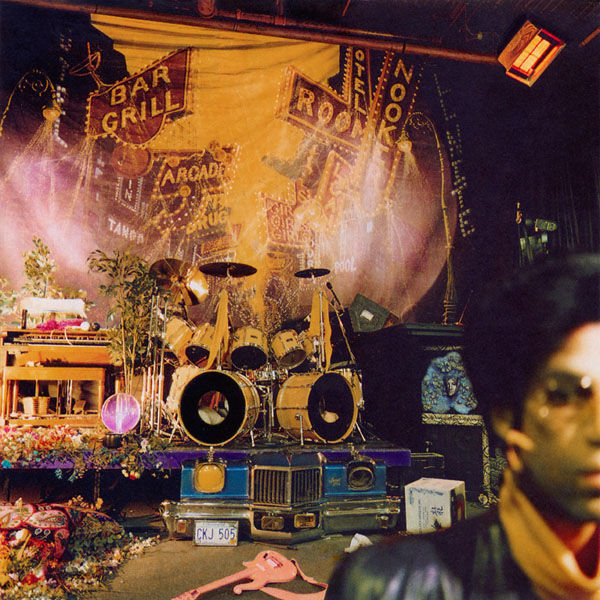
Sign O’ the Times continued to haunt me without my being aware of it. 1989 the summer after high school I was hanging out with my friend Kristi and she played me a cassingle of “Hot Thing.” This blew me away. I listened to a lot of electronic pop music at the time like New Order and Depeche Mode and I loved the electronic textures and rhythms in this song. I couldn’t believe Prince had a song out like this and I had never heard it before and I didn’t know it existed. I did not realize it was a song off Sign O’ the Times. It existed in a vacuum of cassingleness. Note that I never went dancing and I never went to parties. Never. I didn’t know any of the Prince club songs. Only the radio hits. And never the albums. Those never came into my family’s home.
The summer of 1989 Prince also released “Batdance” the leadoff single from his Batman soundtrack album. Now I was not only a superhero/comic book obsessive and an intense fan of what Frank Miller had recently done with the character, but I loved the early Batman TV series from childhood and I LOVED the theme song. I was really excited as I watched the “Batdance” video for the first time with Prince performing the track in his Batcave. This initial excitement faded when I realized that he was not going to surpass the greatness of the original theme. I still watched that video a lot, but the original theme was the best. I couldn’t stand anything else Prince did for that soundtrack and I hated the film.
Then I went to college.
My roommate my first year at the University of Oregon was several years older than me and in college on the GI Bill after years of service in the Navy. Jason was a Prince obsessive. All he listened to was Prince. His entire music collection was every Prince cassette. (OK, there were two exceptions of which I was aware: a Guy cassette he saw as not on same level and the Bright Lights, Big City soundtrack which featured the exclusive Prince song “Good Love”) Jason was the only one of us with a car and whenever we drove in his car there was always a Prince cassette in the stereo. Always the same cassette for a period of time until Jason had meditated on it enough and then it was time to switch it out for a different Prince cassette that would be meditated upon for the next several months. When we were first roommates the cassette was 1999. I really didn’t care for Prince’s production and the drum sound he chose especially annoyed me. I could appreciate some of the melodies in the songs, but I really didn’t like the very repetitive and distinctive sound Prince chose for that record. But I was trying. I wanted to get more out of Prince than I had in the past, if only to understand Jason’s devotion. I never warmed up to 1999 that year, but it was an entirely different story when it was time for the Sign O’ the Times cassette to settle in the stereo. I didn’t like everything on it, and some songs I could barely tolerate, but there was “Hot Thing,” which I already knew I liked and then I heard “I Could Never Take the Place of Your Man.” This changed everything. You see, I listened to Hiphop, but otherwise I listened to a lot of pop songs: punk pop, synthpop power pop, noise pop, UK indie. Here was a great guitar pop song. I straight out loved it. It completely shifted my head around about what Prince could do. It was my gateway track into the sprawling Sign O’ the Times double album. I loved parts of it, endured other parts, had no context for much of it, but Sign O’ the Times changed everything about who I thought Prince was and what he was capable of as an artist. I became an especially big fan of other songs on the album like “If I Was Your Girlfriend,” “It,” “Starfish and Coffee,” “Sign O’ the Times” and “Strange Relationship.” The Sign O’ the Times album was the best of the Prince cassettes that made it into Jason’s rotation while we were roommates. The worst was when it was the Batman cassette’s time in the car. That was no fun. I just could not enjoy that album.
Jason was far more sexually experienced than myself. (52 was his current number.) I was clinging tightly to my virginity while Jason had many years of sexual conquests under his belt, often initiated at clubs and often dancing to tracks like his favorite dance song: Prince’s “Erotic City.” I had never even heard of this song before as I had never entered a club; nor did I know Prince B-sides. Jason told me he would make the perfect all-Prince sex tapes to soundtrack his nights of seduction after he and his partner for the night had left the club. The tapes were designed so that once he and his lover were in whatever domicile was serving as the backdrop to their night of lust things would start with dancing before moving horizontal. The entire act of love was preprogrammed sonically for maximum satisfaction. He told me he would time his ejaculation to just the perfect moment during “International Lover” which would always be at the end of side two of his sex tapes. The things you learn from an older, sexually-prolific roommate.
Within three months of being Jason’s roommate and experiencing a heavy immersion in Prince I willingly sacrificed my virginity with my girlfriend and shed my Christianity soon after. I had never considered the possibility that these events were in any way related before sitting down to write this.
In spring of 1990 my music collector instinct was most inspired by artists like the Cure, New Order, the Smiths, Joy Division, Siouxsie and the Banshees, the Jesus and Mary Chain, the Stone Roses and Pixies. I listened to a lot of Hiphop, but I was mostly happy with having cassettes of all the albums and didn’t feel the same urge to search out obscure B-sides or remixes. (One exception I bought was A Tribe Called Quest’s “Can I Kick It” 12″ which had the cool exlusive “If the Papes Come.” RIP Phife Dawg.) For the first time in his life Jason decided to get serious about his Prince collection and go beyond cassettes to rare 12″ singles, 7″s with B-sides, bootlegs, live recordings, etc. It was like a moral obligation that he finally decided to take on, especially due to the curse of living in Oregon which meant that Jason had never had the opportunity to see Prince in concert, despite his deep devotion. One of the reasons he wanted the bootleg vinyl and CD live recordings was so he could live vicariously and imagine the ultimate fantasy of Prince in concert. We toured Eugene record stores and spent one weekend hitting up Portland record stores. I bought 12″s, bootlegs, live recordings, CD singles, whatever it took to get rare and unreleased recordings by the artists I liked, and Jason would do the same for Prince (managing to secure a copy of the then bootleg-only Black Album on vinyl as part of his haul).
Before heading back to Eugene from our Portland record shopping expedition we ate at the original Bangkok Kitchen (R.I.P. Portland’s best-ever Thai restaurant) and Johnny the Waiter deigned to torture us by offering us insanely hot micro peppers to see just how hot we were willing to go in the pursuit of self-immolation. One of the bonds Jason and I shared was that he was in love with insanely-hot Thai food from his time in Thailand while he was in the Navy and I was in love with insanely-hot Thai food from Bangkok Kitchen. It was important for me to treat him to this restaurant since he always talked about how much he missed the real food of Thailand. I’m happy to say Bangkok Kitchen was the best Thai food he had tasted outside of Thailand. (The daughters of the Siripatrapa clan currently run Lemongrass Thai and Khun Pic’s Bahn Thai, both in Portland.)
After dinner Jason merely took a nibble of his micro pepper while I chose to eat a death one whole as a way of trying to equal my father, who I had watched do the same at other Bangkok Kitchen meals in the past. I had never been brave enough before. That pepper destroyed me. I went into a convulsive feverish state. In extreme pain and panic I made my way behind the restaurant counter and began pouring all of the pitchers of water held there into my glass as I drank one glass of water after another. Somehow I made it to the car. As Jason drove us back to Eugene it was Lovesexy‘s turn in the car stereo. The whole ride back to Eugene I shivered and sweated in a delirious haze yet I repeatedly became lucid for a brief moment at the exact same point in the cassette every time it came around during the drive. I have never been able to listen to that album since.

When we got our scores from our record shopping adventures to a friend’s stereo in our dorm (the only guy with a turntable we knew in the hall) I was mostly disappointed with my finds and it would be Jason’s Prince purchases that would have one cool and undiscovered gem after another, whether an extended version, a B-side, an instrumental or a cool remix. That impressed me. If felt like my artists of devotion could barely muster the songs on their albums and offer a few poor throwaways as extras and Prince had endless jewels he strew about either recorded by himself or many other artists. He wasn’t going to waste your money with a lame B-side, he was mostly going to reward you for tracking down the obscurities. Yet one more reason to respect Prince and this awareness expanded my sense of his artistic worthiness even more. He had deep crates; composed solely of his own productions.
After Spring of 1990 Jason and I were no longer roommates. I never again had a Prince fan like him in my life. And yet my time with him permanently altered my opinion of the artist known as Prince, if only through one fan’s devotion and the fact that I was introduced to Sign ‘O the Times, which was the gateway for my appreciation of Prince on the highest artistic level. While I would never be uncritical of Prince’s music or fashion choices or the ideas he expressed, I could never deny his immense stature as an artistic and musical giant even if a lot of what he did didn’t personally appeal to me. It didn’t matter. It wasn’t about me. It was about Prince and what he wanted to share with the world.
Because of Jason’s influence I gave more of an ear to Prince’s newest singles from this point on, even if the only album I made sure to buy right away was Sign O’ the Times. The Graffiti Bridge combination film/album was Prince’s first project to hit after my new artistic respect for him. Unfortunately I only experienced the “Round and Round” video they played with Tevin Campbell all the time on MTV. I hated it. It seemed way too much like an attempt to emulate contemporary R&B and that was a sound I hated and certainly not a direction I wanted Prince to be following. (At the time there was a staunch Hiphop-rules-and-R&B-sucks camp and I was definitely a member. It was not until Aaliyah, Missy Elliott and Timbaland opened my ears that I felt anything but loathing for the sound of contemporary R&B.) I never spent money to learn anything else about that soundtrack and I was susceptible to the popular and media consensus that the film sucked. Despite my love of Sign O’ the Times I was still wary of Prince’s output in general given my repeated forced exposure to his Batman album.
Prince came back for me in October of 1991 with “Gett Off.” It had cheesy raps and cheesy lyrics but it had a groove, it was reaffirmingly licentious and it seemed like a return to form. I had long since left Christianity and my virginity behind and I was happy to have a lewd and lascivious Prince back and grinding and seemingly energized by the experience. The other singles from the album appealed to me not at all at the time and I was dubious of the New Power Generation band so I skipped the album as well.
Indeed I followed that pattern for the rest of Prince’s career. I rarely liked any of his singles and I skipped all his new albums unless I could find them cheap and used and that usually meant years after they came out and even then I would rarely give them much listening time. While I would hold onto them and consider them worthy of revisiting, I would rarely feel the urge. Now this reflects no underestimation of Prince’s talent or capabilities, more my feeling that where Prince was at musically and where I was at as a listener were not aligned for most of his musical career. I, like many fans, now have dozens of albums, side projects and ghosts productions to go back and rediscover that we didn’t give enough of a chance to when they were released.
At some point in college I dubbed some CDs from a friend and made a tape that had Sonic Youth’s Sister on one side and Prince’s Dirty Mind on the other. This tape got a lot of play from me and solidified my appreciation of Prince as Dirty Mind became my favorite album of his after Sign O’ the Times. Sister was the last Sonic Youth album I discovered after listening to everything else by them out at the time. I realized it was my favorite of theirs. That cassette was perfect for discovering two great albums by artists I had listened to a lot without having yet discovered some of their best work.

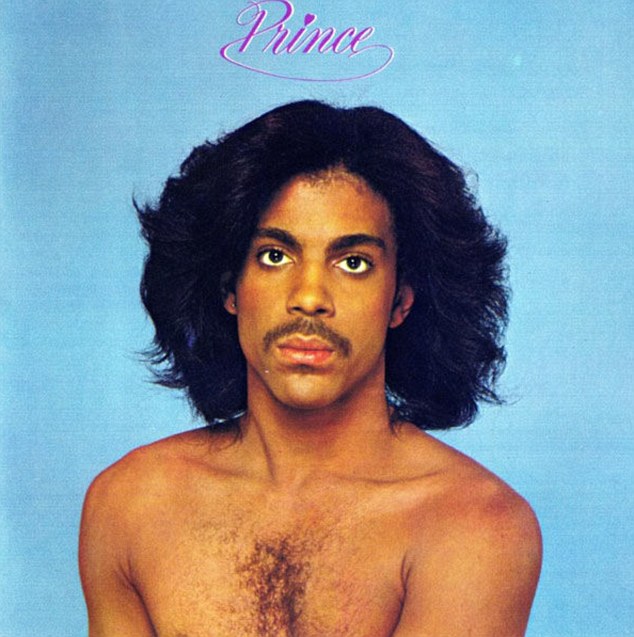
In 1993 I decided to become a vinyl purist and buy nothing but vinyl. I had already sold all my (non-dubbed) cassettes in ’91 and now I felt I was missing something with my collection of mostly CDs. While I always had a small collection of records I decided that from then on I would only buy music on vinyl. I rarely if ever saw newer Prince albums on vinyl, but I assembled a proud collection of his albums up through the bootleg of the Black Album (although I still don’t own For You and am not sure if I have ever heard it). The more Prince came out with new albums that I would barely be aware of, the more I dug into and became a huge fan of his early career.
In 1995 I became a college radio DJ in Eugene on KWVA. I had started attending radio station meetings when I first got to the University of Oregon, but it took several years before the station secured an FCC license and began broadcasting. I only became a DJ on the station at the tail end of my time at college. I don’t know if I ever played Prince on the station. It was all about underground and indie music for me at the time. Prince was probably the only mainstream artist I respected at that point, even if I didn’t care to investigate whatever his latest musical project was.
I kept collecting records and eventually people began to ask me (much to my surprise) to DJ house parties in the late ’90s. At these parties I played Prince. In fact Prince would frequently be requested all night. In fact Prince would be requested no matter how much Prince had already been played. The most reliable thing you could count on at a Portland house party was that Prince would be requested. I once watched another house party DJ follow me with a Prince song. The crowd went wild. Then he played another Prince song. The crowd went WILDER. Then he played a third Prince song. The crowd stayed wild. It was only with the fourth Prince song in a row that the energy of the crowd started to tail off. People who made requests at these parties never wanted new Prince songs. Always old Prince songs. The one newer exception was “P Control” AKA “Pussy Control.” I myself chose to purchase a “Sexy MF” 12″ from the UK and made it a part of my sets, but I don’t remember getting any requests for it. Essentially a Prince request meant an ’80s Prince request.
In September of 1997 Prince was scheduled to play Portland for the first time ever. It was his Jam of the Year tour. I knew what an unprecedented moment this was because I had absorbed my freshman roommate Jason’s yearning for the chance to see Prince live. At the time I was strict about only going to shows that were five dollars or less. I would blow off bands I owned stacks of 7″ singles by if the show was seven bucks. However, for this one and only artist I realized I would pay far, far more. I feel like the tickets I got were 69 bucks. For nosebleeds. I went with my friends Chrysta and Robin and our seats were high up above Prince to his left. Despite the sonically disadvantageous position we were able to watch him dance, leap, do the splits and do the splits while playing guitar and bouncing back up on his feet from the splits while still playing the guitar. In heels. At other times he would somehow play the piano while swinging his leg between his arms and the piano with his impossibly high heels (which apparently gave him hip problems later in life.). Despite the fact that he zipped through his songs with modern DJ ADD ruthlessness at points and focused more on newer songs I didn’t know, I was still blown away by his staggering talent and showmanship. He even rapped convincingly. There was an after party announced and we went sniffing around the venue, but the price seemed high, there was no guarantee that he was going to play and I didn’t need to hang out in a room and watch him sit in VIP; I just wanted to see him play. I had a psychic hit he wouldn’t play, we didn’t go, and he didn’t play. But after spending 69 bucks for nosebleed seats I vowed the next time Prince did play Portland I would spend $169 to get better seats.
So then what happened?
Prince played a show at the 2,776-capacity Arlene Schnitzer concert hall on April 30th, 2002 supporting his Rainbow Children album. I did not attend this show. I remember that the show was billed as more instrumental and more jazzy with less of an emphasis on hits. It was practically billed as the “You’re Sure to Be Disappointed” tour. Did this demotivate me? Did the $50-$125 tickets all of a sudden seem too high for me, or did the show sell out right away? I don’t know. I only know I did not go. One person who was at the show was my mom. Yes, at some point (late ’90s/early ’00s) my mom had shed Evangelical Protestantism and made the choice to get into Prince. I asked her many years later about why and she said she wanted to appreciate a modern genius while they were still alive. Well, she did it.
Normally I wouldn’t think to call my mom after 7:30 pm and she can traditionally be counted on to bow out of late night activity and yet here she was going to see Prince. By herself. A three-hour show. In fact I found out later that even after playing that long show at the Schnitz he appeared at an afterparty at the Roseland Theater that night and he actually did play and he played for hours and for only thirty bucks, far less than the announced show. That I wish I had known about. That I would not have missed. And neither would my mom I was shocked to find out. She said she was so disappointed when she learned the next day about the afterparty as she would have gladly gone after having already listened to him for three hours. Even though the afterparty went until 3:30 am. Such was the magnetic power of Prince that it could overcome the ordinary weakness of the flesh. Well, I missed both shows that night, only one of which I knew about in time. Looking back I would have gone to both shows. But that is hindsight.
I did not make the same mistake the next time Prince came to Portland in September of 2004 with his Musicology tour. He returned to the Rose Garden and played in the round this time. I thought I had a great seat and had a real good view until I visited my mom and sister in their seats which were practically in Prince’s lap. When I got back to my priorly amazing seat it felt so distant and removed I had to struggle to keep from being severely disappointed. Early on in his set he said, “Portland, U don’t know what I have in store for U tonight!” It was electrifying and the crowd roared and as exciting as that moment was it could never be topped for me, because nothing could be beyond the unimaginable promise in that exhortation. That night Prince just wanted to play his guitar and play and play and play. That’s what really stood out to me was how much he just wanted to wail on his guitar. Maceo Parker was in his band and he did a touching tribute to Ray Charles who had died a few months prior.
I didn’t have another chance to see Prince until April of 2013 on his Live Out Loud tour. He announced two last minute shows on the same night at the 1,400 capacity Roseland Theater. I looked up the tickets as soon as I found out. The first show sold out while I deliberated. Why did I hesitate? The shows were 200 dollars each and I had become a full-time DJ the year before. The uncertainty and unpredictability of this business had me very cautious about making any monetary expenditures. In other words, I was broke.
“Fuck it,” I decided. I put it on my credit card.
Quickly both shows were sold out. My mom and I had tickets to the same show and I had the pleasure of accompanying my mom to a late night Prince show. The venue was so small compared to the arena I had seen Prince in twice before. It was incredibly intimate. Prince was shredding RIGHT THERE, looking immortal. Prince was backed up by the all-female power trio 3rdeyegirl on a tour where he just wanted to rock the fuck out in a stripped down format dedicated to guitar noise. At one point he tried to get a call and response going to see how funky the crowd was and the very white Portland crowd failed so badly that Prince started smiling and playing “Play that Funky Music” by Wild Cherry. The crowd got so into into it. This cracks Prince up and what seemed like a joke becomes Prince singing the verses and then the crowd singing the “play that funky music white boy” chorus for the whole song. Prince found the whole thing highly amusing. During his set he had Portland singer Liv Warfield come out and sing with him to the crowd’s adoration. This was a show where Prince just wanted to rock. And he played “Let’s Go Crazy” and “I Could Never Take the Place of Your Man,” two songs I was an instant fan of (a rarity in his catalog) and the second one, the one I really hoped he would play. The one that changed everything for me.
That was the last time. I know now. I am so glad I made the right decision. Credit card debt be damned. He gave a very different, very noisy, very passionate slice of his soul that night. The one he wanted to present, whatever other people’s expectations and desires. Listening to a track like “Bambi” off his second album it is so obvious that this super rocker was always a part of Prince and what seemed so radical to so many people reporting on Prince’s shows with 3rdeyegirl was a facet of the artist that had always been there. He was just shining a bright spotlight on it now. Because that’s what he wanted to do.
After that final Portland show my mom wrote, “It’s 1:40 am. The decibels, pounding amps, screeching, squealing, screaming guitars.The body’s response to the building’s shaking. I’ve never had that experience before. It was so visceral; No way to be anywhere else but in that very moment after moment after moment. wow wow wow”
Thanks, Prince. For a lifetime.
“And together we’ll stare into silence
And we’ll try 2 imagine what it looks like
Yeah, we’ll try 2 imagine what, what silence looks like
Yeah, we’ll try 2 imagine what silence looks like
Yeah, we’ll try…”