It has been nearly five years since Anjali and I have been to India. We’ve wanted to return for several years now, and just weren’t able to make it happen until this year. We hate to leave our Portland supporters without a party for several months, but surely anyone who understands what we do can appreciate our need to spend a chunk of time in India every so often. Ideally we would go for a much longer period of time to immerse ourselves in language, dance, music and cultural studies, but fortunately for those of you who crave a regular fix of our parties, we don’t have any solid plans to do that at this point. However, if the American empire finally arrives at the proper moment to utterly collapse, don’t be surprised if we up and move to India for good.
Without fail, the question I get asked whenever people hear about our trip is: “Are you excited?” In a word: No. Based on my prior two-month trip I would say my emotions are closer to anxiety and apprehension. When I first traveled to India four and a half years ago, I had people warn me about the overwhelming nature of the poverty, and the sheer mass of humanity, but I thought I could handle it. I’d traveled for months in Guatemala and Belize, and I had seen desperation and poverty. Hell, I lived in Cairo, Egypt for two years and there was more than enough humanity and poverty to go around. Having been generally relaxed and adventurous in my previous travels, I was completely unprepared for how stressed out I would be on a moment-by-moment basis in my travels in India.
As a foreigner in India, I simply could not be anonymous and unmolested, as I am accustomed to in Portland. I realized that in the minds of many of the millions of people living in poverty in the urban areas in which I traveled, I only mattered to them to the extent that they could get some money from me. I’m not saying all poor people in India are like this, but those are the only ones I met, since they aggressively followed me in search of a handout. And I couldn’t really fault them for their efforts, since truly, what would be a few dollars for me, would mean a whole lot more to them. Over and over and over I would be approached by people that seemed friendly and desirous of interaction, but sooner or later, I would realize that they wanted something from me, and it served to make me much more suspicious and distrustful when people approached me later in the trip. I got so used to people wanting something from me, and only feigning an interest in interaction, that I walked around walled-off, hostile, and resistant to the people around me.
Our friend Ken was traveling in India at the same time as us, and when we met up with him, he seemed so open and relaxed to the people and experiences in India, that I felt guilty for how distrustful and closed-off I was to the people with whom I came in contact. Ironically, later in his trip, Ken was interacting with a friendly group of young men on a train, who proceeded to steal his bags, throw him from the train, and leave him for dead. Fortunately he lived, escaping with no major injuries, but having lost a lot of money. Hearing about his experience made me question my feelings of guilt about my approach to India. Maybe it wasn’t so bad for me to be so suspicious and paranoid about random people attempting to befriend me in public. Maybe it had saved my life.
And that is the funny thing, no matter how paranoid and cautious I thought I was, it was no where near the level of paranoid and cautious that Anjali’s family in India thought we should be. They said we should never ride a rickshaw at night, and we did this all the time. They said we should never leave a train station until dawn; we left train stations at night in search of lodgings all the time. We would rent private cars with sketchy drivers for trips lasting many hours into the middle of nowhere, and even I thought that it would probably be pretty easy to take us off somewhere and kill us. Clearly we could afford to rent a private car, so clearly we had a lot more money on us where that came from. Anjali’s family would have been horrified that we would take such a risk. You have to wonder about that: what does it mean when the locals are more fearful of India than you are? Is my ignorance and naivete the only thing keeping me from sharing their fears?
One great source of stress on our trip was how hard it was for me to deal with the fact that I could never be left alone in public. After many months I resorted to paying the five rupee fee to enter parks for the rich, where I could experience a few hours of being left alone. In India, privacy costs. Only the well-off can afford solitude. I couldn’t just be in public and be left alone, as I am very accustomed to in Portland. In Bombay I would look at a bench on the waterfront and say, “I’d like to sit on that bench, and just relax.” Of course the second Anjali and I would attempt something of the sort, we would be mobbed by people begging for money. I don’t resent their poverty and desperation, I am just not very psychologically well-equipped to deal with the constant barrage of need. Driving down the street, our car surrounded by young children attempting to forcibly squeeze their limbs through the windows, begging for money at every major intersection, traumatized me multiple times a day. How can I care for all these people? I may as well attempt to empty the ocean with a teaspoon. Whether I gave money or not, I knew I could do little to change the overwhelming sadness of the lives of these many desperate millions. It was very instructive to see how the middle class locals handled the poor, as they are surrounded by this poverty their entire lives. I witnessed a range of responses, from handing money to beggars, to chasing them off in a flurry of aggressive gestures and yelling.
Even being in a hotel room was no relief from demanding humans, as in each hotel in which we stayed we experienced the hotel staff finding any excuse to bother us every few minutes, to the point where I felt under siege. I felt obligated to tip for every visit, which no doubt served to encourage their visits, and I jealously hoarded small bills, as I lived in fear of a hotel worker arriving at my room expecting a tip when all I had was 500 rupee notes. If I ordered bottled water, towels, parantha and some curds, you better believe every item was brought separately, including the silverware, and the napkins, and I would feel obligated to tip every time, having no idea what proper etiquette was, and not wanting to be some unappreciative asshole foreigner who didn’t tip.
This was a constant problem for me, not knowing what the local customs were, and what was expected of me. It’s not like I didn’t try to learn. I asked lots of questions of friends and family in India, I read culture and travel tips in my guides, but I still wasn’t confident about when to tip, when not to, and how much. If someone acted like they were waiting for a tip, they got one. Maybe I gave way too much. Maybe I got taken for a ride. I just didn’t want to come off as ungrateful.
Another area in which the difference between Indian etiquette and politeness and American etiquette and politeness caused me a great deal of stress had to do with relations between friends. In America I was taught to say “Thank you,” but to our Indian hosts this was very offensive and distasteful. Rude. Saying “thank you,” was far too formal, and meant that I doubted the sincerity and genuineness of their actions. The different communication styles between Indians and Americans had me constantly confused as to what our hosts really wanted, because they would never say what they really felt, I was just supposed to divine this through subtle cultural cues that I didn’t understand or even know how to look for. Did they really want us to stay another week, or were they just saying that to be polite, with the full expectation that we would shortly go to our room to pack our bags? No one seemed willing to directly communicate what they wanted. If they offered something, maybe I was supposed to refuse it. If they said something was OK, maybe it really wasn’t. I felt very awkward and uncomfortable often, because I couldn’t tell what my hosts really wanted me to do. Although they clearly knew what they wanted me to do, they would just never tell me directly, and I couldn’t decipher the cultural cues. It was often only after I guessed wrongly about what the desired response was from me was in a particular situation, that I could sense the disappointment, and realize that I failed to take the correct course of action to please my hosts.
I also have trouble understanding Indian English. Many people may not realize this, but South Asia has more English speakers than anywhere else in the world, and before long, their English will be the Standard English. This is a big problem for me personally, as I have a very hard time understanding it. Not the pronunciation, necessarily, but the way sentences and questions are formed (in the same grammatical manner as Hindi) often has me playing a back and forth game with someone trying to get a simple question answered in a way that I can understand. No matter how many times they reply, I still don’t have an answer I understand. Sometimes this would happen simply because the one syllable I really needed to hear would be blurred in string of words. I would have ten-minute phone conversations with hotel front desk staff trying to determine if a room was “awailable” or “unawailable.” Back and forth, back and forth.
“So a room is awailable?”
“A room is -mumble-wailable, Sir.”
“Awailable or unawailable?”
“-mumble-wailable, Sir.”
Aaaaarrggh.
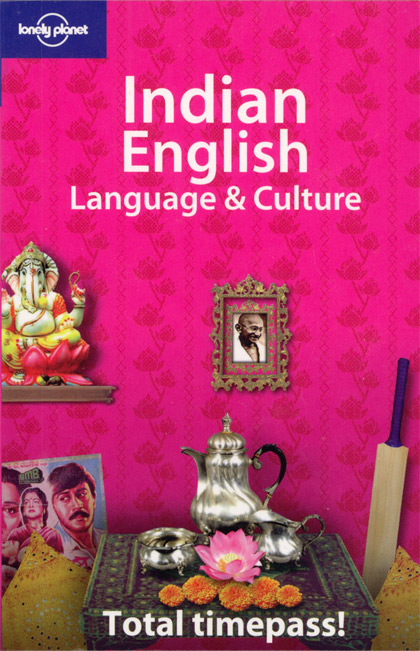
Fortunately Lonely Planet has recently published a guide to Indian English, for the perplexed such as myself.
Once a waiter came up to our table and asked me a question. I didn’t understand what he was asking, thought he was talking in Hindi, and turned to Anjali for a translation. Apparently he had not been talking to me in Hindi, but asked if I wanted my water cold or room temperature, in English, and I thought he speaking to me in a foreign language.
All our traveling on our last trip was done between Pune and Chandigarh, with time spent in Madhya Pradesh, so I only know what that part of India was like to travel in. This time we hope to spend a month in the South, which everyone says is much more mellow, so maybe all of my negative experiences have to do with traveling in Central and North India, and I will realize that not all of India is like that. If I survive, I’ll be sure to let you know.
IK